If You Live in an Area That Was Flooded by the 100-year Flood Last Year, You Can Conclude That

A 100-year flood is a flood event that has a one in 100 chance (i% probability) of being equaled or exceeded in any given year.[1]
The 100-year flood is also referred to as the 1% flood, since its annual exceedance probability is ane%.[2] For coastal or lake flooding, the 100-year flood is more often than not expressed as a inundation elevation or depth, and may include moving ridge effects. For river systems, the 100-year overflowing is generally expressed as a flowrate. Based on the expected 100-yr inundation menstruum rate, the flood h2o level tin can be mapped every bit an area of alluvion. The resulting floodplain map is referred to every bit the 100-year floodplain. Estimates of the 100-year flood flowrate and other streamflow statistics for any stream in the The states are available.[3] In the UK The Environment Agency publishes a comprehensive map of all areas at adventure of a 1 in 100 yr alluvion.[4] Areas near the coast of an sea or large lake also can exist flooded by combinations of tide, storm surge, and waves.[v] Maps of the riverine or littoral 100-yr floodplain may figure importantly in edifice permits, environmental regulations, and flood insurance.
Probability [edit]
A common misunderstanding is that a 100-year flood is likely to occur only one time in a 100-year catamenia. In fact, there is approximately a 63.4% risk of one or more 100-twelvemonth floods occurring in any 100-year period. On the Danube River at Passau, Germany, the actual intervals between 100-twelvemonth floods during 1501 to 2022 ranged from 37 to 192 years.[half dozen] The probability Pdue east that one or more floods occurring during whatsoever period will exceed a given flood threshold can be expressed, using the binomial distribution, as
![P_{{e}}=1-\left[1-\left({\frac {1}{T}}\right)\right]^{{n}}](https://wikimedia.org/api/rest_v1/media/math/render/svg/7a04aed785379fa1f0e7de7c1804a84391616c2d)
where T is the threshold render catamenia (e.thousand. 100-twelvemonth, l-yr, 25-yr, and so forth), and n is the number of years in the period. The probability of exceedance Peastward is besides described as the natural, inherent, or hydrologic chance of failure.[7] [8] However, the expected value of the number of 100-twelvemonth floods occurring in any 100-year catamenia is ane.
X-year floods have a ten% chance of occurring in any given year (Pe =0.10); 500-year have a 0.2% chance of occurring in any given year (Pe =0.002); etc. The percent run a risk of an X-year flood occurring in a single year is 100/Ten. A similar analysis is commonly applied to coastal flooding or rainfall data. The recurrence interval of a storm is rarely identical to that of an associated riverine flood, because of rainfall timing and location variations among different drainage basins.
The field of extreme value theory was created to model rare events such as 100-yr floods for the purposes of civil engineering. This theory is most usually applied to the maximum or minimum observed stream flows of a given river. In desert areas where at that place are merely imperceptible washes, this method is applied to the maximum observed rainfall over a given period of time (24-hours, half dozen-hours, or 3-hours). The extreme value assay only considers the most extreme event observed in a given year. So, between the large bound runoff and a heavy summertime rain storm, whichever resulted in more than runoff would exist considered the extreme upshot, while the smaller consequence would be ignored in the analysis (fifty-fifty though both may have been capable of causing terrible flooding in their own right).
Statistical assumptions [edit]
There are a number of assumptions that are made to complete the analysis that determines the 100-year inundation. First, the extreme events observed in each year must be independent from yr to year. In other words, the maximum river menstruum rate from 1984 cannot be found to be significantly correlated with the observed flow rate in 1985, which cannot be correlated with 1986, and so forth. The second assumption is that the observed farthermost events must come from the aforementioned probability density function. The third supposition is that the probability distribution relates to the largest storm (rainfall or river flow rate measurement) that occurs in any one yr. The quaternary assumption is that the probability distribution role is stationary, significant that the hateful (average), standard difference and maximum and minimum values are not increasing or decreasing over fourth dimension. This concept is referred to as stationarity.[viii] [9]
The first assumption is often simply non ever valid and should be tested on a case-by-instance basis. The second assumption is often valid if the extreme events are observed under similar climate weather. For instance, if the extreme events on record all come from tardily summertime thunderstorms (as is the case in the southwest U.South.), or from snow pack melting (every bit is the case in n-central U.Southward.), and so this assumption should be valid. If, however, there are some farthermost events taken from thunder storms, others from snow pack melting, and others from hurricanes, and then this supposition is almost likely not valid. The third assumption is only a trouble when trying to forecast a depression, merely maximum menses event (for case, an event smaller than a two-year flood). Since this is not typically a goal in extreme assay, or in civil engineering design, then the situation rarely presents itself. The final assumption about stationarity is difficult to exam from data for a single site considering of the big uncertainties in even the longest overflowing records[6] (see next section). More broadly, substantial evidence of climate change strongly suggests that the probability distribution is also irresolute[10] and that managing inundation risks in the future will become fifty-fifty more than difficult.[eleven] The simplest implication of this is that not all of the historical data are, or tin be, considered valid as input into the farthermost event assay.
Probability uncertainty [edit]
When these assumptions are violated there is an unknown amount of uncertainty introduced into the reported value of what the 100-yr alluvion ways in terms of rainfall intensity, or alluvion depth. When all of the inputs are known the uncertainty can be measured in the form of a confidence interval. For example, i might say there is a 95% chance that the 100-twelvemonth flood is greater than X, only less than Y.[ii]
Straight statistical analysis[9] [12] to estimate the 100-year riverine flood is possible only at the relatively few locations where an annual serial of maximum instantaneous inundation discharges has been recorded. In the United States as of 2014, taxpayers have supported such records for at least 60 years at fewer than ii,600 locations, for at least 90 years at fewer than 500, and for at to the lowest degree 120 years at only 11.[13] For comparison, the total area of the nation is nigh 3,800,000 foursquare miles (9,800,000 km2), and so there are peradventure 3,000 stream reaches that bleed watersheds of 1,000 square miles (2,600 kmtwo) and 300,000 reaches that bleed 10 square miles (26 kmtwo). In urban areas, 100-year alluvion estimates are needed for watersheds equally pocket-size as 1 foursquare mile (2.6 km2). For reaches without sufficient data for directly analysis, 100-year overflowing estimates are derived from indirect statistical assay of flood records at other locations in a hydrologically like region or from other hydrologic models. Similarly for littoral floods, tide gauge data exist for only about 1,450 sites worldwide, of which only most 950 added information to the global information center betwixt January 2010 and March 2016.[14]
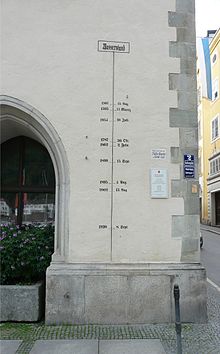
Much longer records of flood elevations exist at a few locations around the globe, such as the Danube River at Passau, Germany, just they must exist evaluated carefully for accuracy and completeness before whatsoever statistical estimation.
For an private stream reach, the uncertainties in any analysis can be large, so 100-year alluvion estimates have large individual uncertainties for nearly stream reaches.[6] : 24 For the largest recorded flood at any specific location, or whatever potentially larger event, the recurrence interval always is poorly known.[6] : 20, 24 Spatial variability adds more than doubtfulness, because a flood superlative observed at unlike locations on the aforementioned stream during the same event unremarkably represents a unlike recurrence interval at each location.[6] : twenty If an farthermost tempest drops enough pelting on one branch of a river to cause a 100-year inundation, just no rain falls over some other branch, the flood wave downstream from their junction might have a recurrence interval of simply x years. Conversely, a storm that produces a 25-twelvemonth flood simultaneously in each branch might grade a 100-year flood downstream. During a fourth dimension of flooding, news accounts necessarily simplify the story by reporting the greatest damage and largest recurrence interval estimated at any location. The public can easily and incorrectly conclude that the recurrence interval applies to all stream reaches in the inundation expanse.[6] : 7, 24
Observed intervals betwixt floods [edit]
Peak elevations of fourteen floods every bit early as 1501 on the Danube River at Passau, Frg, reveal bully variability in the actual intervals between floods.[half-dozen] : 16–19 Flood events greater than the 50-year alluvion occurred at intervals of 4 to 192 years since 1501, and the 50-year flood of 2002 was followed simply 11 years later by a 500-year alluvion. Just half of the intervals between 50- and 100-year floods were within 50 percent of the nominal average interval. Similarly, the intervals between 5-yr floods during 1955 to 2007 ranged from 5 months to xvi years, and only half were inside ii.five to 7.five years.

Observed intervals betwixt floods at Passau, 1501-2013
Regulatory use [edit]
In the United States, the 100-year flood provides the adventure footing for flood insurance rates. Complete information on the National Alluvion Insurance Plan (NFIP) is available here. A regulatory overflowing or base flood is routinely established for river reaches through a science-based dominion-making procedure targeted to a 100-year flood at the historical average recurrence interval. In addition to historical flood data, the procedure accounts for previously established regulatory values, the effects of flood-control reservoirs, and changes in land use in the watershed. Coastal overflowing hazards have been mapped by a like approach that includes the relevant physical processes. Almost areas where serious floods tin can occur in the United States have been mapped consistently in this mode. On average nationwide, those 100-year flood estimates are well sufficient for the purposes of the NFIP and offering reasonable estimates of futurity flood adventure, if the hereafter is like the past.[half-dozen] : 24 Approximately 3% of the U.S. population lives in areas subject to the ane% annual hazard coastal alluvion hazard.[15]
In theory, removing homes and businesses from areas that flood repeatedly tin protect people and reduce insurance losses, only in practice it is difficult for people to retreat from established neighborhoods.[16]
Run into also [edit]
- Extreme value theory
- Farthermost weather
- Flood forecasting
- Frequency of exceedance
- List of floods
- Lists of floods in the United States
References [edit]
- ^ Viessman, Warren (1977). Introduction to Hydrology . Harper & Row, Publishers, Inc. p. 160. ISBN0-7002-2497-ane.
- ^ a b Holmes, R.R., Jr., and Dinicola, K. (2010) 100-Yr inundation–it'south all most chance U.Southward. Geological Survey General Information Production 106
- ^ Ries, M.G., and others (2008) StreamStats: A h2o resources web application U.South. Geological Survey, Fact Canvas 2008-3067 Application abode page URL accessed 2015-07-12.
- ^ "Flood Map for Planning (Rivers and Sea)". Environment Agency. 2016. Archived from the original on 2016-09-16. Retrieved 25 August 2016.
- ^ "Littoral Flooding". FloodSmart. National Flood Insurance Plan. Archived from the original on 2016-03-08. Retrieved 7 March 2016.
- ^ a b c d e f grand h Eychaner, J.H. (2015) Lessons from a 500-year record of flood elevations Association of State Floodplain Managers, Technical Written report vii URL accessed 2021-11-20.
- ^ Mays, L.W (2005) Water Resources Engineering, chapter ten, Probability, adventure, and uncertainty assay for hydrologic and hydraulic design Hoboken: J. Wiley & Sons
- ^ a b Maidment, D.R. ed.(1993) Handbook of Hydrology, affiliate 18, Frequency analysis of extreme events New York: McGraw-Hill
- ^ a b England, John; and seven others (29 March 2018). Guidelines for determining flood flow frequency—Bulletin 17C. U.S. Geological Survey. Retrieved 2 October 2018.
- ^ Milly, P. C. D.; Betancourt, J.; Falkenmark, M.; Hirsch, R. K.; Kundzewicz, Z. Westward.; Lettenmaier, D. P.; Stouffer, R. J. (2008-02-01). "Stationarity is Expressionless". Science Mag. Sciencemag.org. 319 (5863): 573–574. doi:10.1126/scientific discipline.1151915. PMID 18239110. S2CID 206509974.
- ^ Intergovernmental Panel on Climate Change (2012) Managing the risks of farthermost events and disasters to advance climatic change adaptation, Summary for policymakers Archived 2015-07-19 at the Wayback Automobile Cambridge and New York: Cambridge University Printing, 19 p.
- ^ "Bulletin 17C". Advisory Committee on Water Information. Retrieved 2 Oct 2018.
- ^ National H2o Information System database U.S. Geological Survey. URL accessed 2014-01-30.
- ^ "Obtaining Tide Gauge Information". Permanent Service for Mean Sea Level. PSMSL. Retrieved seven March 2016.
- ^ Crowell, Marker; others (2010). "An gauge of the U.S. population living in 100-year coastal inundation hazard areas" (PDF). Journal of Coastal Research. 26 (ii): 201–211. doi:10.2112/JCOASTRES-D-09-00076.1. S2CID 9381124. Archived from the original (PDF) on 17 Oct 2016. Retrieved half-dozen March 2016.
- ^ Schwartz, Jen (i August 2018). "Surrendering to rising seas". Scientific American. 319 (2): 44–55. doi:10.1038/scientificamerican0818-44. PMID 30020899. Retrieved two October 2018.
External links [edit]
- "What is a 100 year flood?". Boulder Area Sustainability Information Network (BASIN). URL accessed 2006-06-sixteen.
Source: https://en.wikipedia.org/wiki/100-year_flood
0 Response to "If You Live in an Area That Was Flooded by the 100-year Flood Last Year, You Can Conclude That"
Postar um comentário