Hg Wells the Flat Earth Again
fringey —
I watched an unabridged Flat Earth Convention for my research—here'southward what I learned
Shifts in who has ability to spread data accept led to a resurgence in fringe ideas.

Enlarge / Large inflatable globe getting hugged by a woman in a red brim.
Getty Images
Speakers recently flew in from around (or perchance, across?) the World for a iii-twenty-four hour period event held in Birmingham: the U.k.'s first ever public Apartment Earth Convention. It was well attended, and it wasn't just three days of speeches and YouTube clips (though, granted, there was a lot of this). At that place was also a lot of team-building, networking, debating, workshops—and scientific experiments.
Yes, flat-Earthers do seem to identify a lot of emphasis and priority on scientific methods and, in particular, on observable facts. The weekend in no small part revolved effectually discussing and debating scientific discipline, with lots of time spent running, planning, and reporting on the latest set of apartment-Earth experiments and models. Indeed, as one presenter noted early, flat-Earthers try to "look for multiple, verifiable evidence" and brash attendees to "e'er do your own research and accept you might be wrong."
While flat-Earthers seem to trust and support scientific methods, what they don't trust is scientists, and the established relationships betwixt "power" and "noesis." This human relationship betwixt ability and knowledge has long been theorized by sociologists. Past exploring this relationship, we can brainstorm to empathize why there is a swelling resurgence of flat-Earthers.
Power and noesis
Let me begin by stating quickly that I'm not really interested in discussing if the Earth if apartment or not (for the tape, I'm happily a "globe-Earther")—and I'm not seeking to mock or denigrate this community. What's important hither is not necessarily whether anyone believes the Earth is flat or non, but instead what the flat-Earthers' resurgence and public conventions tell united states of america about scientific discipline and noesis in the 21st century.
Throughout the weekend, multiple competing models of Globe shapes were suggested, including "classic" apartment Earth, domes, ice walls, diamonds, puddles with multiple worlds inside, and even the Globe as the within of a giant catholic egg. However, the give-and-take oftentimes did not revolve around the models on offer, but on broader bug of attitudes towards existing structures of knowledge, and the institutions that supported and presented these structures.
The cosmic egg theory explained.
Flat-Earthers are non the beginning group to exist skeptical of existing power structures and their tight grasps on knowledge. This viewpoint is somewhat typified past the work of Michel Foucault, a famous and heavily influential 20th century philosopher who fabricated a career of studying those on the fringes of order to understand what they could tell us about everyday life.
He is well known, amidst many other things, for looking at the close relationship between ability and knowledge. He suggested that knowledge is created and used in a way that reinforces the claims to legitimacy of those in power. At the same time, those in ability control what is considered to exist right and incorrect noesis. According to Foucault, there is therefore an intimate and interlinked relationship betwixt power and knowledge.
At the time Foucault was writing on the topic, the control of power and knowledge had moved away from religious institutions, who previously held a very singular agree over noesis and morality, and was instead beginning to move towards a network of scientific institutions, media monopolies, legal courts, and bureaucratized governments. Foucault argued that these institutions work to maintain their claims to legitimacy by decision-making cognition.
Ahead of the curve?
In the 21st century, we are witnessing another important shift in both power and cognition due to factors that include the increased public platforms afforded by social media. Knowledge is no longer centrally controlled and—as has been pointed out in the wake of Brexit—the historic period of the expert may be passing. At present, everybody has the power to create and share content. When Michael Gove, a leading proponent of Brexit, proclaimed: "I think the people of this country have had plenty of experts," it would seem that he, in many ways, meant it.
It is also clear that nosotros're seeing increased polarization in society, as we keep to drift away from agreed singular narratives and motility into camps around shared interests. Recent Pew research suggests, for example, that fourscore percent of voters who backed Hillary Clinton in the 2016 United states presidential election—and 81 percent of Trump voters—believe the two sides are unable to concord on basic facts.
Despite early on claims that a worldwide shared resource of noesis such as the internet would create peace, harmony, and a common interpretation of reality (this idea comes from as far back as HG Well's "world brain" essays in 1936), it appears that quite the reverse has happened. With the increased vocalism afforded past social media, cognition has been increasingly decentralized, and competing narratives have emerged.
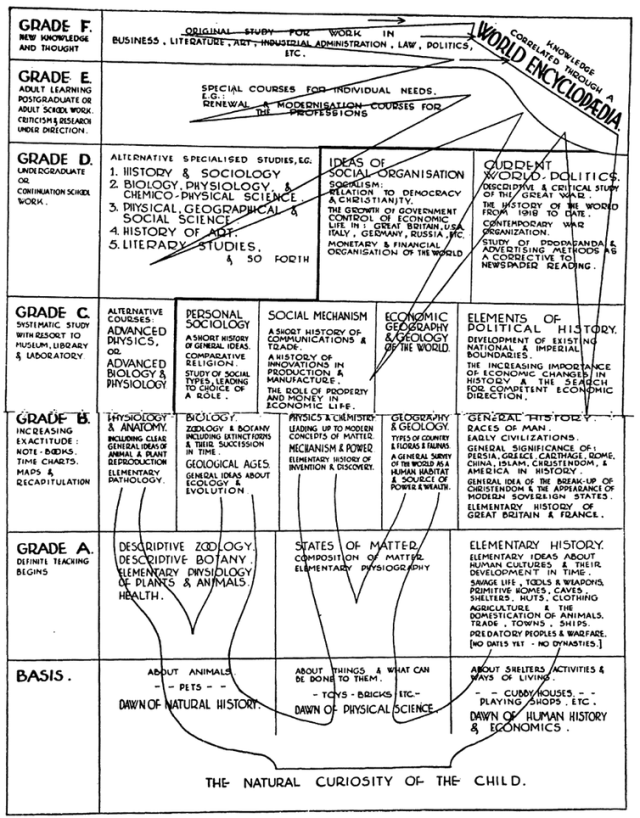
Enlarge / HG Wells' plan for a earth encyclopedia.
Scottbot
This was something of a reoccurring theme throughout the weekend, and was particularly credible when four apartment-Earthers debated iii physics PhD students. A particular point of contention occurred when one of the physicists pleaded with the audition to avoid trusting YouTube and bloggers. The audience and the console of flat-Earthers took exception to this, noting that "now we've got the Internet and mass communication … we're not reliant on what the mainstream are telling usa in newspapers, nosotros tin decide for ourselves." Information technology was readily apparent that the apartment-Earthers were corking to separate noesis from scientific institutions.
Apartment-Earthers and populism
At the same time as scientific claims to cognition and ability are being undermined, some ability structures are decoupling themselves from scientific noesis, moving towards a kind of populist politics that are increasingly skeptical of knowledge. This has, in recent years, manifested itself in extreme ways—through such things as public politicians showing support for Pizzagate or Trump's suggestions that Ted Cruz's begetter shot JFK.
Merely this can also be seen in more than subtle and insidious course in the way in which Brexit, for example, was campaigned for in terms of gut feelings and emotions rather than expert statistics and predictions. Science is increasingly facing bug with its ability to communicate ideas publicly, a problem that politicians, and apartment-Earthers, are able to circumvent with moves towards populism.
Once again, this theme occurred throughout the weekend. Flat-Earthers were encouraged to trust "poetry, freedom, passion, vividness, creativity, and yearning" over the more clinical regurgitation of established theories and facts. Attendees were told that "hope changes everything," and warned confronting blindly trusting what they were told. This is a narrative echoed past some of the celebrities who have used their power to back flat-Earth beliefs, such as the musician B.O.B, who tweeted: "Don't believe what I say, inquiry what I say."
The cities in the background are approx. 16miles apart... where is the bend ? delight explain this moving picture.twitter.com/YCJVBdOWX7
— B.o.B (@bobatl) January 25, 2016
In many means, a public coming together of apartment-Earthers is a production and sign of our time; a reflection of our increasing distrust in scientific institutions, and the moves by ability-holding institutions towards populism and emotions. In much the same way that Foucault reflected on what social outcasts could reveal nigh our social systems, in that location is a lot flat-Earthers can reveal to the states well-nigh the current changing human relationship betwixt power and noesis. And judging past the success of this U.k. issue—and the large conventions planned in Canada and America this year—information technology seems the flat-Earth is going to exist around for a while even so.
This article was originally published on The Conversation.
List image by Getty Images
Source: https://arstechnica.com/science/2018/05/i-watched-an-entire-flat-earth-convention-for-my-research-heres-what-i-learned/
0 Response to "Hg Wells the Flat Earth Again"
Postar um comentário